Commercial epoxy floors · Kelowna, BC
Epoxy Floor Coatings for Commercial Spaces in Kelowna
Bare concrete dusts, stains and soaks up oil, and in a busy shop or warehouse it never quite looks clean. Pacific Painting Kelowna installs commercial epoxy flooring for auto shops, warehouses, showrooms, clinics, retail back rooms and food service areas in Kelowna, West Kelowna and Lake Country. Our team brings more than 15 years of painting and coatings experience, and we treat floor prep with the same care as the coating itself.
We work with business owners, facility and property managers, and general contractors fitting out new commercial units. Every commercial floor starts with a slab assessment: we check moisture, old coatings, oil contamination, cracks and joints, then recommend a system that suits the traffic, chemicals and cleaning routine in that space. Concrete is diamond ground before anything is applied, because the bond to the slab decides whether the floor lasts.
We are licensed, insured and covered by WorkSafeBC, and our installation work carries a written 1-year labour warranty. Installs can be phased by section or scheduled over weekends so operations keep running, with fast-cure options where downtime is tight. Homeowners looking for a garage floor should see our residential garage floor epoxy service, which is set up for one and two car garages.
Where Commercial Epoxy Works Best
Epoxy suits any space where concrete takes abuse and needs to stay cleanable. These are the floors we are asked to coat most.
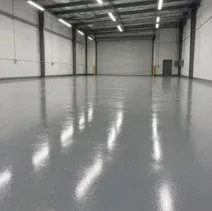
Warehouses and Distribution
A thick solid-colour epoxy stops concrete dusting onto stock and stands up to pallet jacks. Light grey brightens the space and makes spills easy to spot.
Auto Shops and Service Bays
Oil, brake fluid and hot tires are hard on floors. A chemical-resistant epoxy base with a urethane or polyaspartic topcoat holds up and mops clean.
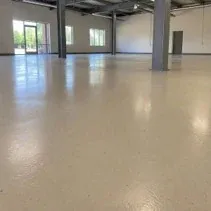
Showrooms and Retail
Flake finishes give a showroom polish without the cost of tile. A satin topcoat hides scuffs better than high gloss.
Food Service and Breweries
Seamless coatings leave no grout lines to trap food or water. Areas with hot washdowns may need a heavier system, which we flag at the assessment.
Clinics and Labs
Smooth, non-porous floors are easy to disinfect. Low-odour products and after-hours installs keep patient areas open.
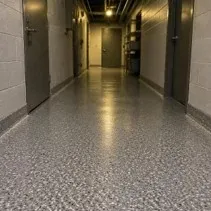
Corridors and Back Rooms
Service corridors, storage and mechanical rooms get a durable flake floor that hides wear and stays clean between deep cleans.
Coating Systems Compared
No single coating suits every floor. The right system depends on traffic, chemicals, temperature, cleaning methods and how long you can be closed.
| System | Strengths | Limits | Good fit |
|---|---|---|---|
| 100% solids epoxy, solid colour | Thick, hard film with strong chemical and abrasion resistance | Ambers and fades under UV without a topcoat; slower cure | Warehouses, shops, mechanical rooms |
| Epoxy with flake broadcast | Hides dirt and wear, adds texture and grip | Needs a clear topcoat to seal the flakes | Showrooms, corridors, change rooms |
| Epoxy with quartz broadcast | Very hard-wearing and slip-resistant | Rougher texture takes more effort to mop | Wet areas, ramps, back-of-house |
| Polyaspartic topcoat or system | Fast cure, UV-stable, good abrasion resistance | Short pot life; must be installed by experienced crews | Fast turnarounds, sunlit floors near overhead doors |
| Urethane topcoat over epoxy | Better scratch and UV resistance than epoxy alone | Adds a coat and cure time | Showrooms and retail with daylight |
| Urethane cement | Handles hot water, steam cleaning and thermal shock | Heavier, more costly system | Commercial kitchens and food processing with hot washdowns |
Epoxy is the workhorse base coat, but on its own it yellows in sunlight and scratches under steel wheels. That is why we usually recommend finishing commercial floors with a urethane or polyaspartic topcoat, chosen for the traffic and the light in the room.
Homeowners comparing systems for a garage will find the residential version, with flake options and garage pricing, on our garage floor epoxy page.
Surface Prep and Moisture Testing
Most epoxy floor failures trace back to prep. Peeling, bubbling and hot tire pickup start at the slab, not in the bucket.
Degrease and test the slab
Oil and grease are scrubbed out with a degreaser, and old coatings and sealers are tested to see whether they must come off.
Test for moisture
Concrete that releases too much water vapour pushes coatings off as blisters. We test with methods such as in-slab relative humidity probes (ASTM F2170) or calcium chloride tests (ASTM F1869), and new slabs normally cure at least 28 days first.
Diamond grind
Planetary grinders with vacuum dust extraction open the surface to a profile in the range of ICRI CSP 2 to 3 for most thin and mid-build systems. Acid etching does not give a reliable profile, so we do not rely on it.
Repair cracks and joints
Cracks and spalls are filled with epoxy or polyurea repair material. Control joints are filled with a semi-rigid filler or honoured through the coating so the slab can still move.
Prime, coat and topcoat
A primer penetrates the ground concrete, then build coats, any broadcast and the topcoat follow within each product's recoat window.
If testing shows high moisture, the options are a moisture-mitigating epoxy primer or a breathable alternative. We give you the numbers and the choice before work starts.
Slip Resistance and Safety Lines
Anti-Slip Aggregates
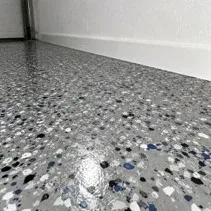
A glossy epoxy floor can be slippery when wet or oily. We mix a fine anti-slip aggregate such as aluminum oxide into the topcoat, or broadcast quartz for heavier grip on ramps and wash areas.
More texture means more grip but harder cleaning, so we match the level to the room and can show you sample boards first.
Walkways and Forklift Lanes
Pedestrian walkways, forklift lanes, hazard zones and storage outlines are best painted onto the new coating while it is still fresh enough to bond well. We lay them out with you to match your workflow.
For parking areas, loading zones and parkades, see our line striping and parkade painting service.
Installing Without Shutting Down
Few businesses can close for a week. We plan the install around your operations.
- Phased sections. Large floors are split into zones so stock and equipment move to one side while the other side is coated.
- Weekend and overnight installs. Grinding and coating run while you are closed, with the floor ready for foot traffic by the next shift where the system allows.
- Fast-cure topcoats. Polyaspartic topcoats can take light traffic within hours rather than a full day.
- Dust and odour control. Grinders run with vacuum extraction, and we ventilate and seal off adjoining areas during coating.
Cold slabs slow curing a lot, so winter installs need the building heated before and after the work. We confirm temperatures before booking.
Commercial Epoxy Costs
Commercial epoxy floors typically run $5 to $12 per sq ft, including materials. Your written quote is itemised after we assess the slab.
| Price driver | Effect on cost |
|---|---|
| Floor size | Larger floors cost less per sq ft because setup and grinding are spread out |
| Prep needed | Removing old coatings, oil contamination and crack repair add time |
| Moisture results | A moisture-mitigating primer adds a coat and material |
| System and thickness | Solid colour epoxy is at the low end; flake, quartz and polyaspartic topcoats move it up |
| Scheduling | Weekend, overnight and phased installs add labour |
Our 1-year labour warranty covers delamination, peeling or bubbling caused by our installation. It does not cover impact damage, chemicals beyond the system's rating, or moisture failures where testing showed a risk and mitigation was declined. Compare our other commercial rates on the painting costs in Kelowna page.
Commercial Epoxy FAQs
How long until forklifts can use the floor?
For a standard epoxy system at room temperature, plan on light foot traffic after about 24 hours, vehicles after about 3 days and forklifts or heavy loads after about 7 days. Polyaspartic systems can return to service much faster, often foot traffic within hours and vehicles the next day. Cold slabs stretch every one of these times.
Can you coat over an old epoxy or sealer?
Sometimes. If the old coating is well bonded, we grind it to give the new system something to grip. If it is peeling or the sealer is incompatible, it has to come off first.
Is epoxy safe for food areas?
Fully cured epoxy and urethane systems are widely used in food service because they are seamless, non-absorbent and easy to sanitize. Floors must be fully cured before food is handled, and areas with hot washdowns may need urethane cement instead. Check your plans with your Interior Health environmental health officer before work starts.
How do I clean a commercial epoxy floor?
Sweep or dust mop daily and wash with a neutral pH cleaner and an auto-scrubber or mop. Avoid harsh solvents and acidic cleaners unless the system is rated for them.
Keep exploring
Related to commercial epoxy floors
Line Striping
Walkway, safety and forklift lines painted onto your new floor.
Read moreGarage Floor Epoxy
Our flake epoxy system sized and priced for home garages.
Read moreCommercial Kitchen Painting
Washable walls and ceilings to go with a new kitchen floor.
Read moreCommercial Painting
Offices, shops, restaurants, apartment buildings, floors and parking lots painted around your business hours.
Read morePainting Costs
Typical 2026 price ranges for interior, exterior, cabinet, deck, epoxy and commercial painting in Kelowna, with worked examples.
Read moreService Areas
Kelowna, West Kelowna, Westbank First Nation lands, Lake Country and communities within a 30-minute drive.
Read more
Commercial slab assessments
Book a Floor Assessment
Call 778-946-5725 or send the form to book a visit. We check the slab and recommend a system, and you get a written quote from a licensed, WorkSafeBC-covered crew with 15+ years of experience and a 1-year labour warranty.
- 15+ years experience
- Licensed & insured
- WCB coverage
- 1-year labour warranty
Mon to Fri 7 a.m. to 8 p.m. · Sat 8 a.m. to 8 p.m. · Sun 8 a.m. to 6 p.m.
Loading the estimate form…
Or call 778-946-5725 or email info@pacificpaintingbc.com.